
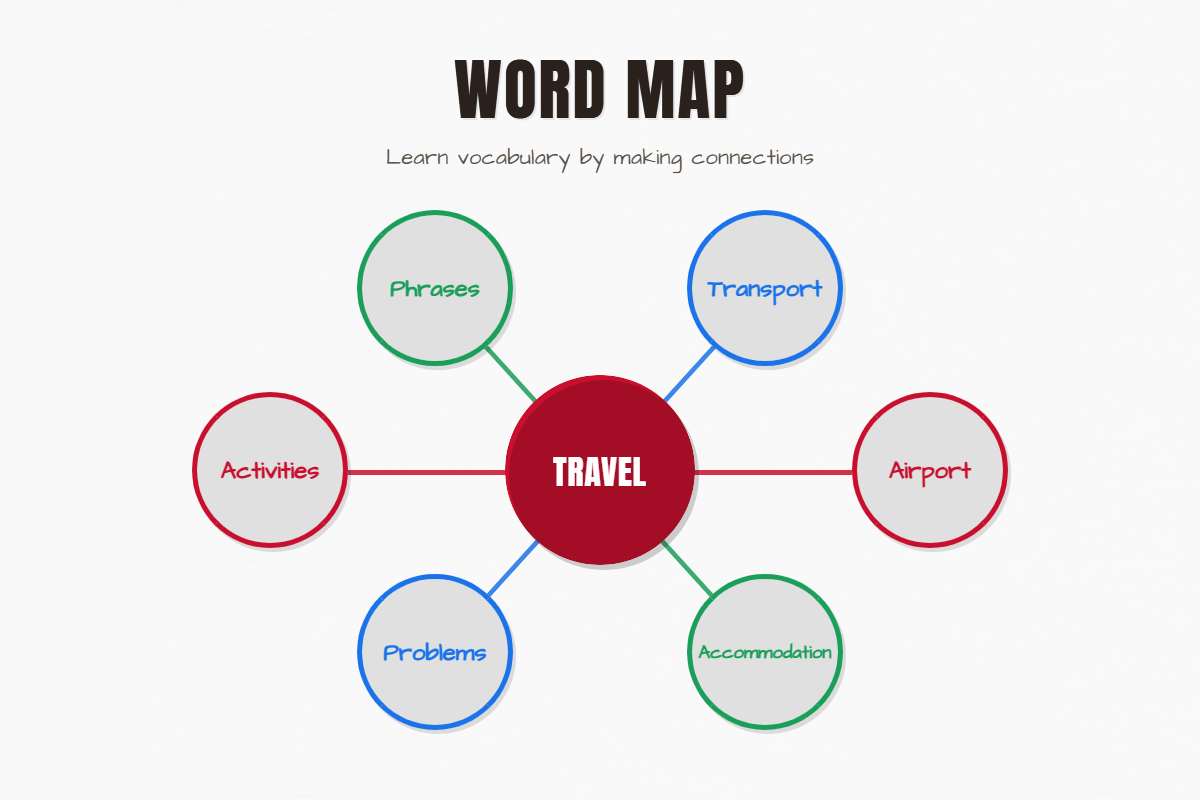
Learning vocabulary isn’t just about memorising lists of individual words. A word map helps you organise vocabulary, see connections between words, and practise using them in context.
Why Create a Word Map?
Creating your own word map can help you:
- Remember vocabulary more easily: grouping related words creates connections that can make them easier to recall later.
- Activate vocabulary you already know: starting with a central topic encourages you to think about words you already have but may not use very often.
- Identify gaps in your vocabulary: you may discover that you know the basic words for a topic but are missing the vocabulary you need for specific situations.
- Understand how words are connected: organising words into categories helps you see relationships between words rather than learning them as isolated items.
- Practise vocabulary in context: writing example sentences helps you understand how words are actually used, including common grammar and expressions.
- Build your own vocabulary resource: your word maps can be added to and reviewed over time, creating a personalised vocabulary bank based on the topics that are important to you.
Don’t just learn individual words, build connections between them.
How to Build Your Own Word Map
- Pick a central word: Choose a theme (e.g., food, shopping, school).
- Create categories: Think of 4-6 subtopics related to your theme.
- List vocabulary: Under each subtopic, write specific words or phrases.
- Add sentences: Write example sentences for each word to show how they are used in context.
Tip: Don’t worry about finding the “perfect” words. Start with the vocabulary you already know, then use your map to identify new words you need to learn.
Sample Word Map: Travel
Here is a sample word map you can use as a template. The central word is TRAVEL, broken down into six categories.
1. Transport
- plane
- train
- bus
- taxi
- rental car
Example sentences:
- I usually travel by train.
- We took a taxi to the airport.
2. Airport
- passport
- boarding pass
- check-in
- security
- departure gate
Example sentences:
- Where is the check-in desk?
- I need to show my passport.
3. Accommodation
- hotel
- hostel
- room
- reservation
- reception
Example sentences:
- I booked a hotel near the city centre.
- I have a reservation for two nights.
4. Problems
- delayed
- cancelled
- lost luggage
- overbooked
- missed flight
Example sentences:
- Our flight was delayed by two hours.
- My luggage has been lost.
5. Activities
- sightseeing
- swimming
- hiking
- shopping
- sightseeing tour
Example sentences:
- We went sightseeing in the afternoon.
- I’d like to go on a sightseeing tour.
6. Useful Phrases
- How much is a ticket?
- Where can I buy a ticket?
- What time does the train leave?
- I’d like to check in.
- Could you help me with my luggage?
Leave a Reply