
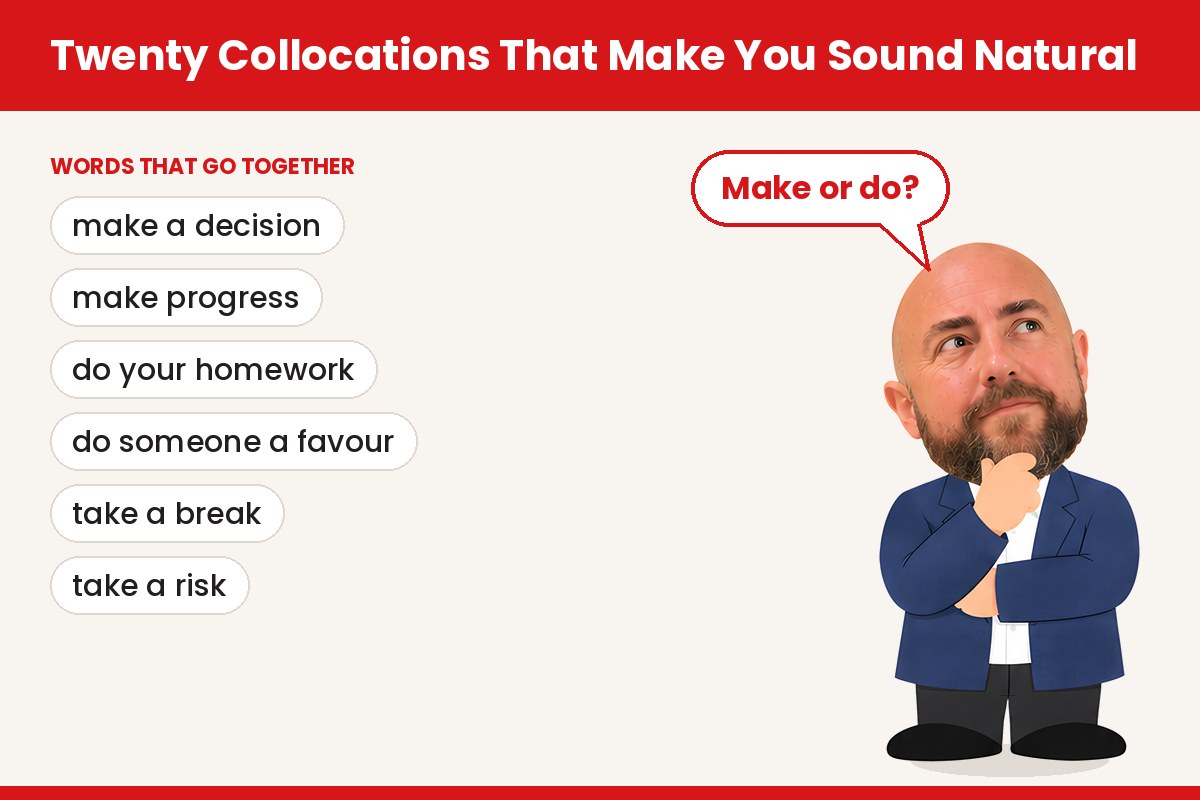
There is a stage in learning English where your grammar is correct, your vocabulary is broad, and something still sounds off. You say “I did a decision” or “I want to make my homework”. Nobody misunderstands you. But nobody would have said it that way.
What is missing is collocation. English pairs certain words with certain other words, and the pairings are not decided by logic. Make and do both mean roughly “produce” or “perform”, yet you make a decision and do your homework, and swapping them sounds wrong to any native speaker even though neither is more logical than the other.
Collocations cannot be worked out from rules. They have to be collected. Here are twenty that come up constantly.
Make or do
This is the pair that causes the most trouble. A rough guide: make tends to go with things you create or produce, do with tasks and activities. It is only a rough guide, so learn the individual pairs.
- make a decision. I need to make a decision about which job to accept.
- make a suggestion. I would like to make a suggestion about the project.
- make progress. We are making progress on the report.
- do your homework. I have to do my homework before I go out.
- do the laundry. I need to do the laundry before the weekend.
- do someone a favour. Can you do me a favour and pick up my post?
Take
- take a break. Let’s take a break and get a coffee.
- take a risk. Sometimes you have to take a risk.
- take a chance. I took a chance and started my own business.
- take responsibility. You need to take responsibility for your mistakes.
Note that take a risk and take a chance are close but not identical. A risk emphasises possible loss. A chance emphasises possible gain. You take a risk with your savings. You take a chance on a new restaurant.
Get
- get a job. I am trying to get a job after my degree.
- get lost. We got lost on the way to the museum.
Pay, save, run, find
- pay attention. Please pay attention to the instructions. Not give attention.
- save time. Online shopping saves me time.
- run a business. He wants to run a business in tech. Not drive or lead a business.
- find a solution. We need to find a solution quickly.
Fixed expressions
- catch someone’s eye. The bright colours caught my eye.
- break the news. It was hard to break the news to her.
- keep in touch. Let’s keep in touch after we graduate.
- give a presentation. I am giving a presentation on Thursday. Not make or do a presentation.
How to build your own list
The twenty above will help, but twenty is nothing. A fluent speaker carries thousands. The only realistic way to acquire them is to notice them as you read and listen, and to record them as whole phrases.
Three habits that make a real difference:
Record the phrase, not the word. When you meet a new noun, write down the verb that came with it. Not decision but make a decision. Your notebook should be full of phrases, not single words.
Check yourself when you translate. Most collocation errors come from translating the pairing from your own language. If you find yourself building a phrase word by word from your first language, that is the moment to stop and check whether English uses the same combination.
Read material written for adults. Graded readers teach vocabulary. Newspapers, novels and podcasts teach collocation, because they show words in their natural company. Even fifteen minutes a day of real English, with a note of any phrase that surprises you, will do more for how natural you sound than another list of isolated words.
Leave a Reply