
You can arrive in Ireland with a good level of English, sit down in a pub in Galway, and understand almost nothing. This is normal. Irish English has its own vocabulary, its own rhythm, and a heavy reliance on sarcasm and understatement that textbooks do not prepare you for.
What follows is not a list you should memorise and start using. Most of it will sound strange coming from a learner, and some of it is rough enough that you want to hear it in context before you try it. Treat this as listening vocabulary. The aim is to understand what is being said to you.
Greetings and conversation fillers
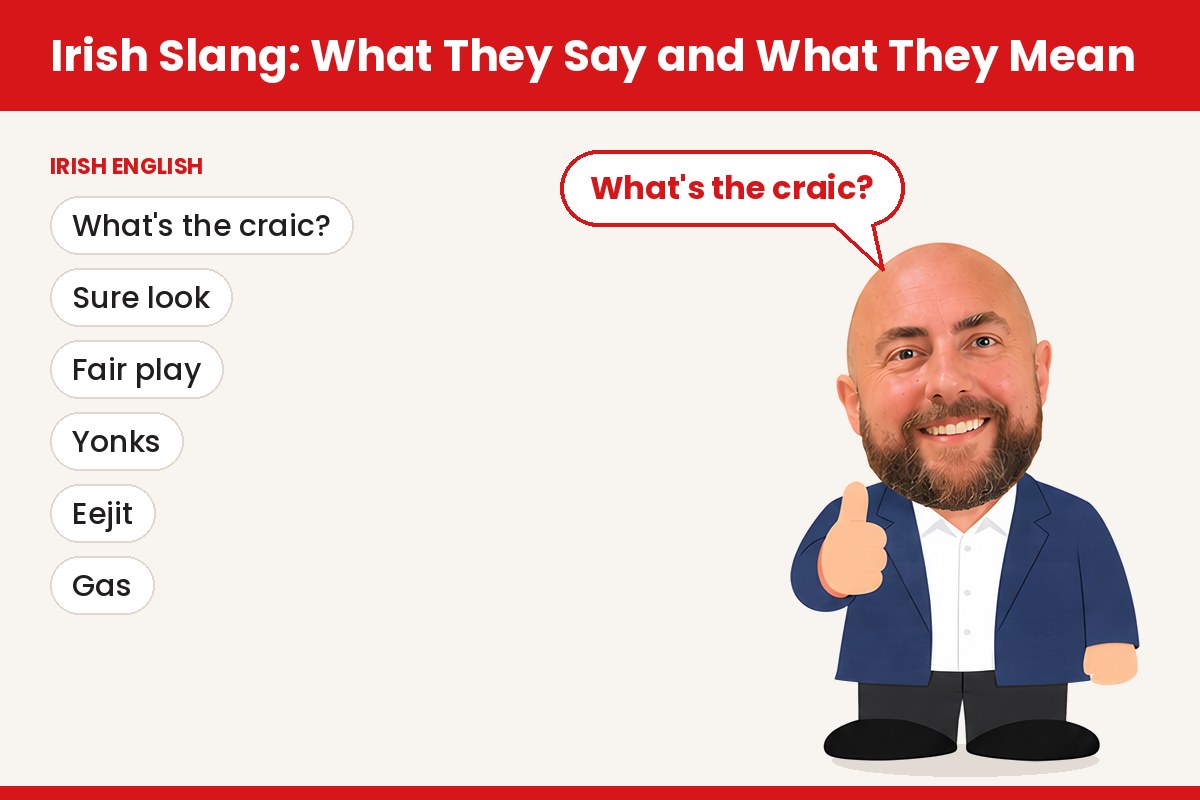
- What’s the story? and What’s the craic? Both mean “how are you” or “what’s happening”. Neither expects a detailed answer.
- How’s she cuttin’? The same thing, more rural, and increasingly old-fashioned.
- C’mere to me. Literally “come here to me”, but nobody is asking you to move. It means “listen, I have something to tell you”.
- Sure look. A filler used to close a subject, usually one nothing can be done about. “Sure look, it is what it is.”
- G’wan. “Go on.” Encouragement, or disbelief, depending entirely on tone.
- Fair play. “Well done.” Very common, and genuinely meant.
- Yonks. A long time. “I haven’t seen you in yonks.”
Craic
The word you will hear most. Craic means fun, enjoyment, or the general atmosphere of an occasion. “The craic was mighty last night” means the night was excellent. Asking “what’s the craic?” is a greeting. Saying a place has “no craic” is a serious criticism.
It is spelled the Irish way but the word came into Irish from English crack, meaning news or gossip, and went back out again in its new form. Learners sometimes assume it is ancient. It is not, but it is now thoroughly Irish.
Describing people
- Gas means funny. “He’s gas.” Nothing to do with fuel.
- Eejit means idiot. Mild, often affectionate.
- Culchie or bogger: someone from rural Ireland. Dubliners apply it to everyone outside Dublin. It can be affectionate or an insult, depending on who is speaking.
- Fella: a man of any age. Yer man and yer one mean “that man” and “that woman” when you cannot remember or do not know the name.
- Oul fella: an older man, or specifically your father. Oul wan is the female equivalent.
- Cailín: girl, borrowed straight from Irish and still used in English sentences.
States and conditions
- Grand. The most useful and most misleading word in Irish English. It means fine, acceptable, adequate. It does not mean magnificent. Depending on tone it can mean anything from genuinely good to barely tolerable. “I’m grand” is the standard answer to “how are you”, and it commits to nothing.
- Knackered: exhausted.
- Banjaxed: broken, not working. “The engine is banjaxed.”
- Manky: filthy or disgusting. Often used about the weather.
- In bits: in a bad state, physically or emotionally.
- Up to ninety: extremely busy or stressed.
- A bad dose: a bad case of an illness. “A fierce bad dose of the flu.”
Intensifiers
Fierce and pure both mean “very”, and both are used constantly. “It’s fierce cold out.” “He’s pure delighted.” Desperate, confusingly, is often used to mean “very bad” rather than desperate in the standard sense: “the weather was desperate.”
The pub
- On the lash: out drinking.
- A few scoops: a few drinks.
- Langers, scuttered, locked: very drunk. Ireland has a long list of these, and the general rule is that almost any past participle can be pressed into service.
- Minerals: soft drinks. Mainly used by older speakers.
The sarcasm problem
This is the part that catches learners out, because the words are simple and the meaning is the opposite of what they say.
“I will, yeah.” This means “I absolutely will not.” The intonation carries the whole meaning. If you ask someone to do something and they say “I will, yeah”, they are refusing.
“G’way outta that.” Depending on context: disbelief, a deflection of a compliment, or “don’t be silly, of course you will”.
“Not too bad” in answer to how you are usually means things are fine. Irish English understates positive things and often overstates negative ones for comic effect.
The general principle is that a flat statement is often not literal. If a response seems oddly short or oddly enthusiastic, listen to the tone rather than the words.
A word of caution
Some Irish slang is coarse. Dryshite (a boring person), arseways (done wrong), feckin’ (a softened swear word) and several others in common use are fine among friends and wrong in a job interview. As a learner you carry no accent-based licence for this, so a word that sounds affectionate from a local can sound aggressive from a stranger.
Understand it all. Use the safe half: craic, grand, fair play, gas, knackered. Leave the rest to the locals until you have heard it enough times to know exactly who says it and when.
Leave a Reply