
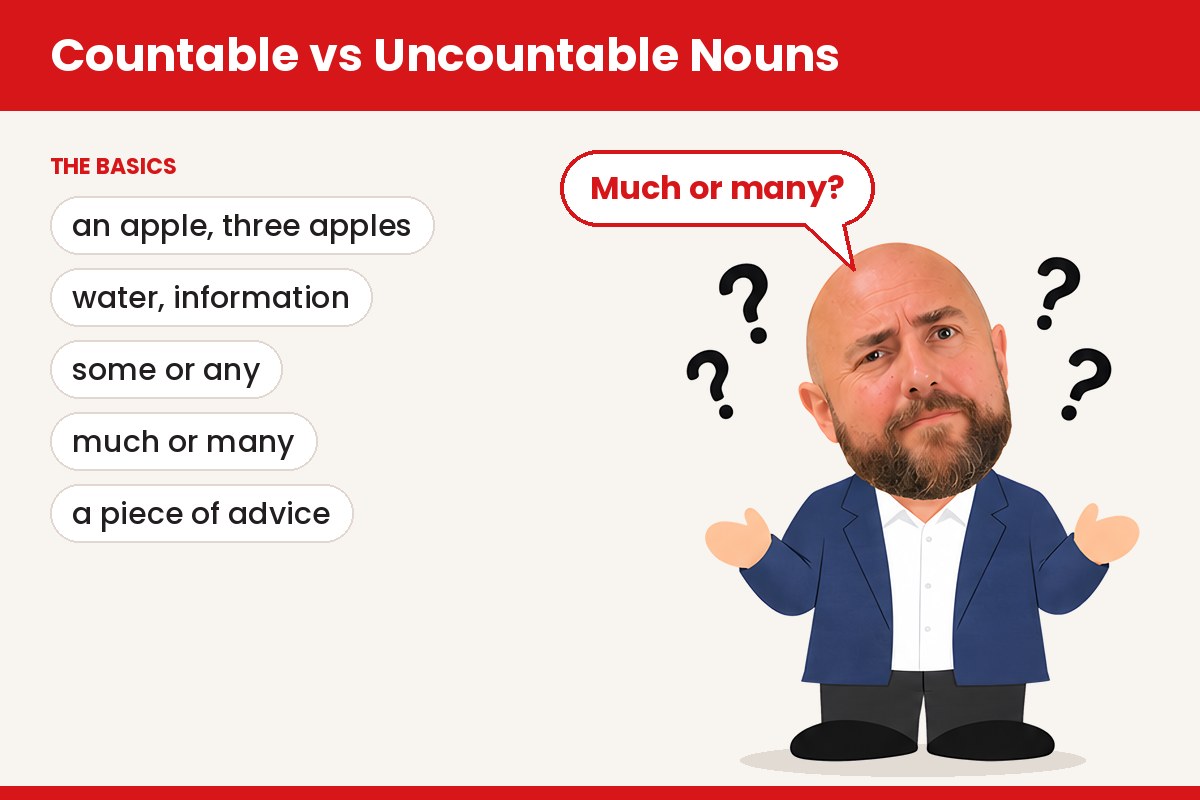
Things you can count one by one, and things you can’t.
Countable
Structure: a/an + noun, has a plural
an apple → three apples
Things you can count one by one.
Uncountable
Structure: no a/an, no plural
water, information, advice
Treated as one whole mass, not individual units.
Some / Any
Structure: some (positive) / any (question, negative)
I have some water. / Do you have any water?
Works for both countable and uncountable nouns.
Much / Many
Structure: many + countable / much + uncountable
How many apples? / How much water?
Many counts items, much measures a mass.
A Lot Of / Lots Of
Structure: a lot of / lots of + either
I have a lot of books. / I have a lot of water.
Works for both, and more common in speech than much/many in positive sentences.
A Few / A Little
Structure: a few + countable / a little + uncountable
a few apples / a little water
A small but positive amount: enough to matter, not “none.”
Few / Little (No “A”)
Structure: few + countable / little + uncountable
few people came / little hope left
Drop the “a” and the meaning flips negative: almost none, not enough.
Tricky Uncountables
Structure: no plural, even though learners expect one
advice, information, furniture, news, luggage
These are uncountable in English but often countable in other languages: never “an advice” or “informations.”
Leave a Reply