
Can, must, should: the words that shade how strong a statement is.
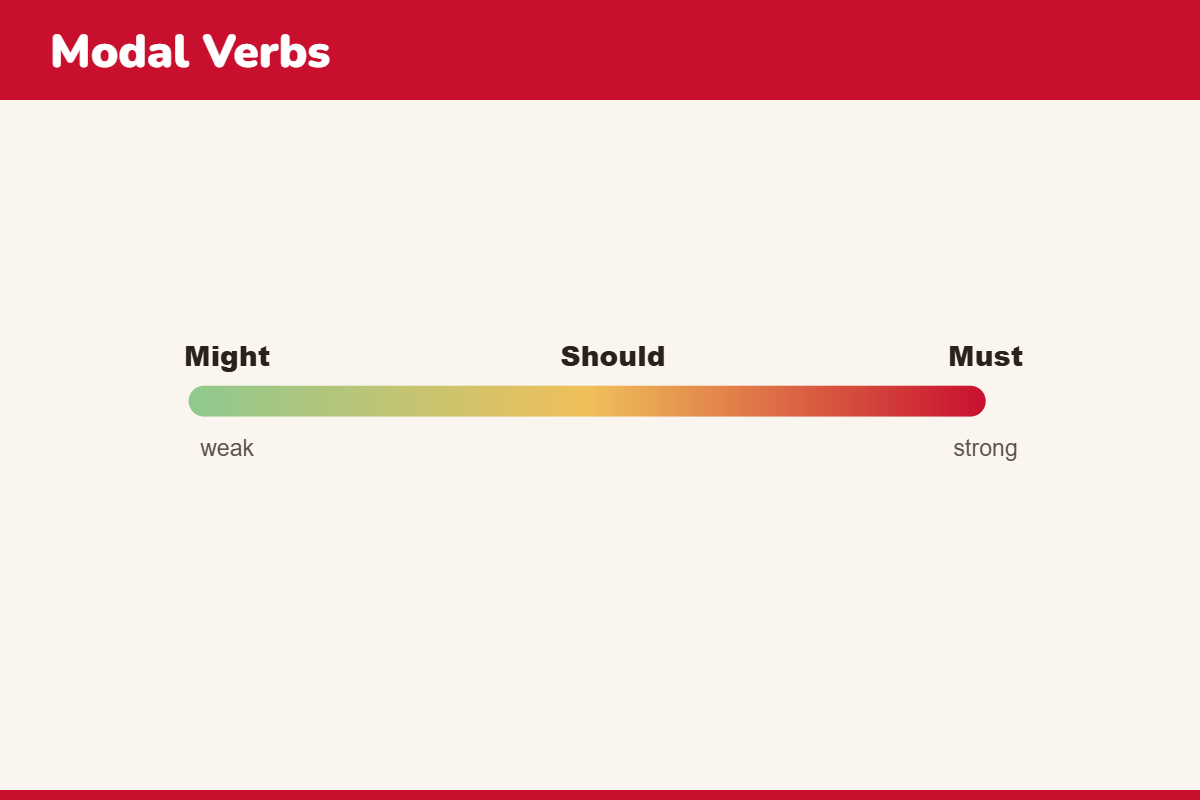
How Strong Is It?
Same modal idea, different jobs — this scale is just for the obligation/necessity line. Possibility, prediction and deduction each get their own logic in the cards below.
Can / Could
Structure: can / could + base verb
I can swim. / Could you help me?
Ability (can), or a polite request (could).
Must / Have To
Structure: must / have to + base verb
You must wear a seatbelt.
“Must” often feels like the speaker’s own rule; “have to” feels more external.
Should / Ought To
Structure: should / ought to + base verb
You should see a doctor. / You ought to call her back.
Advice or a recommendation, not an order. “Ought to” means the same thing, just more formal and less common in speech.
Mustn’t vs Don’t Have To
Structure: forbidden vs optional
You mustn’t smoke here. (forbidden) vs You don’t have to come. (optional)
These look similar but mean opposite things: one bans it, the other just makes it optional.
May / Might
Structure: may / might + base verb
It may rain later. / You may leave the room.
Possibility (may/might are close to interchangeable here, might slightly less certain), or formal permission (may only).
Will
Structure: will + base verb
She will call you tomorrow. / I’ll get the door.
A prediction, a promise, or a decision made right at the moment of speaking.
Would
Structure: would + base verb
Would you like some tea? / I would help if I could. / We would go there every summer.
A polite offer or request, a hypothetical, or a repeated action in the past.
Shall
Structure: shall + base verb
Shall we dance? / Shall I open a window?
A formal suggestion or offer, mostly with I/we. Rare outside British English and formal writing.
Must vs Can’t (Deduction)
Structure: near-certain positive vs near-certain negative
She must be exhausted. vs That can’t be right.
Not obligation here, but logical certainty from evidence. “Must” concludes yes, “can’t” concludes no.
Should Have / Must Have
Structure: modal + have + past participle
You should have called me. / He must have left already.
A regret about what didn’t happen (should have), or a confident guess about what did (must have).
Leave a Reply