
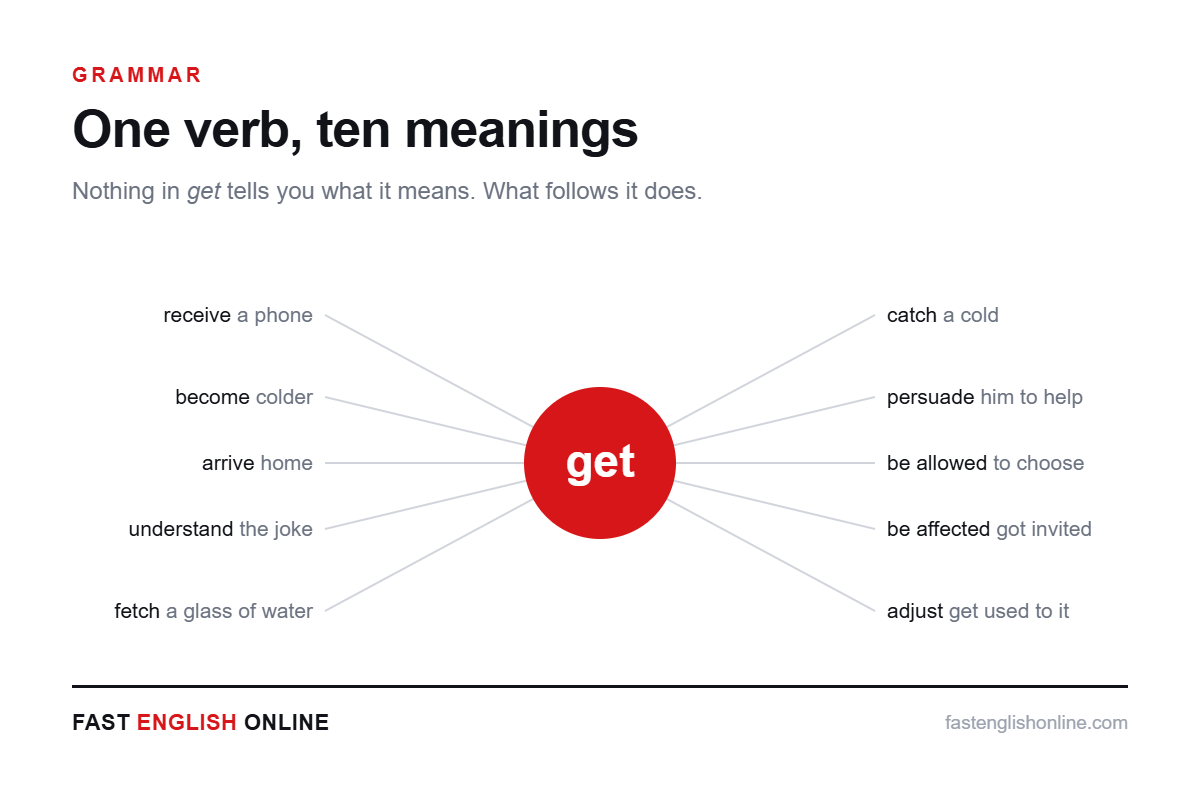
If you had to pick the single most useful verb in spoken English, a strong case could be made for get. It is not elegant. Style guides tell writers to avoid it. But in ordinary conversation it does more work than almost any other verb, and learners who avoid it end up sounding stiff and formal in situations that call for neither.
The difficulty is that get has no single meaning. It takes its meaning from what follows it. Once you see the patterns, the whole thing becomes manageable.
The main meanings
1. To receive or obtain
The most literal use. I got a new phone for my birthday. She got a promotion at work.
2. To become
Followed by an adjective, get means change of state. It is getting colder. He got tired after the long walk. She is getting better at singing. This use is extremely common and almost always replaces the more formal become in speech.
3. To arrive
We got to the station just in time. What time do you usually get home? Note that get to takes a place, but get home takes no preposition.
4. To understand
I get what you mean. She did not get the joke. The negative, “I don’t get it”, is one of the most frequent phrases in spoken English.
5. To catch an illness
He got the flu last week. I think I am getting a cold.
6. To fetch
Can you get me a glass of water? I need to get my coat from the bedroom.
7. To cause someone to act
Followed by a person and an infinitive. I could not get him to help me. She finally got me to go to the gym.
8. To have the opportunity
Followed by to plus a verb, with no object in between. I got to meet the president. He gets to choose the film tonight. This is different from meaning 7, and the difference is the object. I got him to go means I persuaded him. I got to go means I was allowed to.
9. As a passive
In informal English, get often replaces be in passive constructions, usually when the event is unexpected or unwelcome. I got stuck in traffic. She got invited to the party. He got fired.
10. To become accustomed
Always get used to, and the thing that follows is a noun or an -ing form, never an infinitive. It took me a while to get used to the new schedule. He is still getting used to working nights.
Phrasal verbs with get
Adding a particle changes the meaning completely. These are the ones worth knowing first.
- get up: to rise from bed or from a seat. I get up at seven every day.
- get along or get on (with someone): to have a good relationship. Do you get on with your colleagues?
- get over: to recover from an illness or a setback. It took me a while to get over the flu.
- get by: to manage, usually with just enough. It is tight, but we get by.
- get through: to finish or survive something demanding. I need to get through these reports by five.
- get ahead: to progress, especially at work. She worked hard to get ahead.
- get rid of: to dispose of. I need to get rid of these old clothes.
- get out: to leave. Let’s get out of here.
- get into: to become involved in, or to develop an interest in. I got into an argument. She is getting into cooking.
Two things learners get wrong
The first is get used to versus used to. These look similar and mean different things. I used to smoke describes a past habit that has stopped. I am getting used to the noise describes an ongoing process of adjustment. The first takes a bare infinitive, the second takes a noun or -ing.
The second is overcorrection. Learners are often told that get is informal and should be avoided, then avoid it everywhere. In a formal report, yes, prefer receive, obtain, become. In conversation, “I received your message and became tired” sounds odd where “I got your message” and “I got tired” are what a native speaker would say. Register matters more than the individual word.
Practice
Take the nine phrasal verbs above and write one true sentence about your own week for each. Not invented examples, real ones. You will remember them far better attached to something that actually happened, and you will find out quickly which ones you cannot yet use naturally.
Leave a Reply